1780 – The Official Blog of Transylvania University

1780 | The Official Blog of Transylvania University

Learning by Design

Self-designed Majors Expand Opportunities It’s a familiar refrain for students coming into college: What major do I want to declare? But increasingly, as the world becomes more diverse and the job market becomes less specialized, Transylvania students are asking themselves a different question: What problem do I want to solve? Transy has 47 majors that, paired with a broad liberal arts curriculum, are designed to give students a breadth of knowledge and depth of preparation that empower them to take on a wide variety of careers and graduate schools. In a community like Transy’s, which is full of young explorers, there will always be those students whose education goals don’t fit neatly into one of those established major patterns. That’s why Transylvania has devoted itself to offering self-designed majors where students can tailor their individual paths to the world’s challenges they feel drawn to tackle. In close collaboration with faculty advisors and the Office of the Registrar, students can craft a curriculum built around their interests, knowing that the training they get here will uniquely prepare them for what lies ahead. “When I got to Transy, I was highly interested in biology and highly interested in computer science,” said Jerry Ramey ’11, “but the course loads of those majors didn’t work so well together for me.” Ramey met with biology professor Belinda Sly and then-computer science professor Tylene Garrett, who began working with him to craft a program that would

The Art of Problem Solving

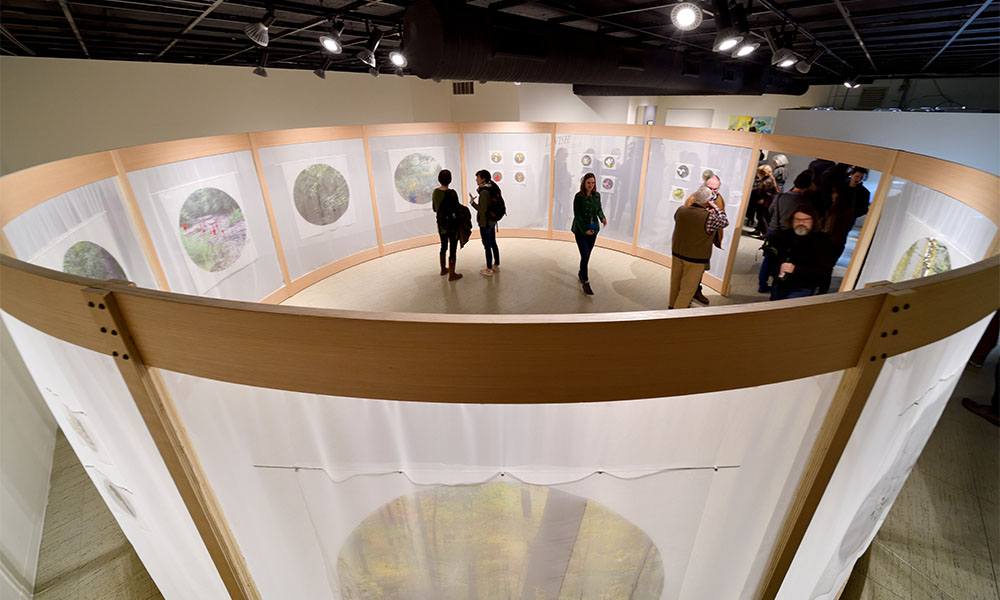
Zoé Strecker Brings Pine Mountain to Transylvania While admiring the view atop Pine Mountain in southeastern Kentucky, you might not notice the reindeer lichen growing at your feet. Even if you happen to glance down at this pillowy plant, odds are you’ll overlook how it curls at the edges, or how it has four shades of green but appears almost silver. You’d get to know the lichen’s subtleties, though, if you were to sit down for hours at a time to embroider on a photograph of it printed onto silk. This kind of focus fosters a sense of connection—one that shows us how stitching a humble lichen can help us address big problems. In this case the problem is: How can we protect and heighten interest in wild places? Other approaches might have you sit through an eye-glazing lecture about the importance of biodiversity, or learn a fact about the amount of carbon absorbed by a certain acreage of forest. While both are well and good, Transylvania art professor Zoé Strecker takes a different approach; she and her collaborators make art that benefits both natural and human communities—from the coal fields of Kentucky to hurricane-ravaged Puerto Rico. A project of hers called “Lavish!” takes on abstract, challenging economic and social issues through creative work. Transylvania’s Morlan Gallery this past spring featured the embroidery exhibit, which is based on organisms living on Pine Mountain, actually a 125-mile ridge running through the heart of Appalachia. Volunteer embroiderers from across the country stitched vignettes from Strecker’s photos, and she hung them within a circular, wooden structure that measured 22 feet across and 10 feet high. To

How We Think

Carrots. Asteroids. Humanity. It begins with a question or an idea that grips your imagination. How will we reach that asteroid? How will we feed the hungry in Kentucky while reducing food waste? How will we address inequities through public health initiatives in Chicago? The challenge might seem insurmountable in scope—an entrenched social injustice, a shortage of global resources, a citizenry hungry for food. Sometimes the question is posed by someone else, and you know in your heart the solution will lay dormant without you. So the question provokes, nags, inspires, becomes an ineluctable presence in your life. It fixes a vision in your mind of “What if?” and won’t let go until it becomes “How?” and “That’s how.” Pioneers ask big, purposeful questions. But, more to the point, they’re not afraid of jumping in to answer them. They’re able and willing to take risks and give the marrow of themselves as they serve as the catalyst. Where does this come from: this intertwining of deft ability to think strategically, creatively and connectedly; the confidence to take action; a willingness to change with a changing world; and the empathy that compels Pioneers to think beyond themselves? Professor Tim Soulis points to the “ability to think metaphorically,” to see new associations, “to link together ideas that were formerly disconnected and unrelated.” How else can new solutions be found? Part of the DNA of our liberal arts tradition at Transy is a

Transylvania to host Kentucky Bike-Walk Summit

LEXINGTON, Ky.—More than 300 community leaders and advocates from across the state will gather at Transylvania University on Aug. 16-17 for the Kentucky Bike-Walk Summit. The conference will explore how to improve cycling and walking options and safety in Kentucky through a variety of focuses—from government funding to education to design to economic development. “We are thrilled to be hosting the KY Bike-Walk Summit,” Professor of Exercise Science Sharon Brown said. “Participants will celebrate the progress made in recent years and build upon those accomplishments to make Kentucky a healthier, more bike- and pedestrian-friendly place to live and work.” Brown pointed out the progress made since the last summit five years ago in Frankfort, including House Bill 33, which gives cyclists a buffer on the roadways. “We have seen a new three-foot safe passing law enacted to protect cyclists on the roads and the launch of new bike share programs in Richmond, Louisville and northern Kentucky.” Also, new bike paths at the Parklands in Louisville and trails in Eastern Kentucky have attracted tourists. Greg Thomas, secretary of the Kentucky Transportation Cabinet said: “With the recent passage of House Bill 33, the Kentucky Transportation Cabinet has again reiterated its commitment to safety for all modes of transportation. We’re pleased to support the 2018 Kentucky Bike Walk Summit as it seeks to increase education and the awareness of safe practices for two of the Commonwealth’s most accessible—and enjoyable—modes of travel.” The upcoming summit,

Moloney named as Transylvania’s new VP for marketing and communications

LEXINGTON, Ky.—Transylvania University has named Megan Moloney as the institution’s vice president for marketing and communications, effective July 23. During her career Moloney has filled multiple communications and public relations roles for the federal government, including as the director of digital media engagement for the Department of Veterans Affairs and as a public affairs specialist for the Secret Service. She also served as the press secretary for the government’s multi-departmental response to the Deepwater Horizon incident and as a staff member in the White House’s Office of the Press Secretary. She began her career as a producer, anchor and reporter in Oxford, Ohio, and Lexington, Ky., where she worked for WVLK-AM/FM, WLEX-TV and Kentucky Educational Television. “I am truly honored to join President Seamus Carey and the university’s administration in serving the Transylvania family. As someone who grew up in Lexington aware of the school’s historic place in the community, I look forward to working with the university’s faculty, staff, students, alumni and board members to share the stories that make Transylvania a college like no other.” As a member of the president’s cabinet, Moloney will play a key role in the communication and implementation of the university’s strategic plan, which is currently under development. She will also work closely with admissions and advancement staff as they chart the future for the 238-year-old institution. “Megan brings an impressive array of experience to the position as well as a deep appreciation