At first, it was almost a joke.
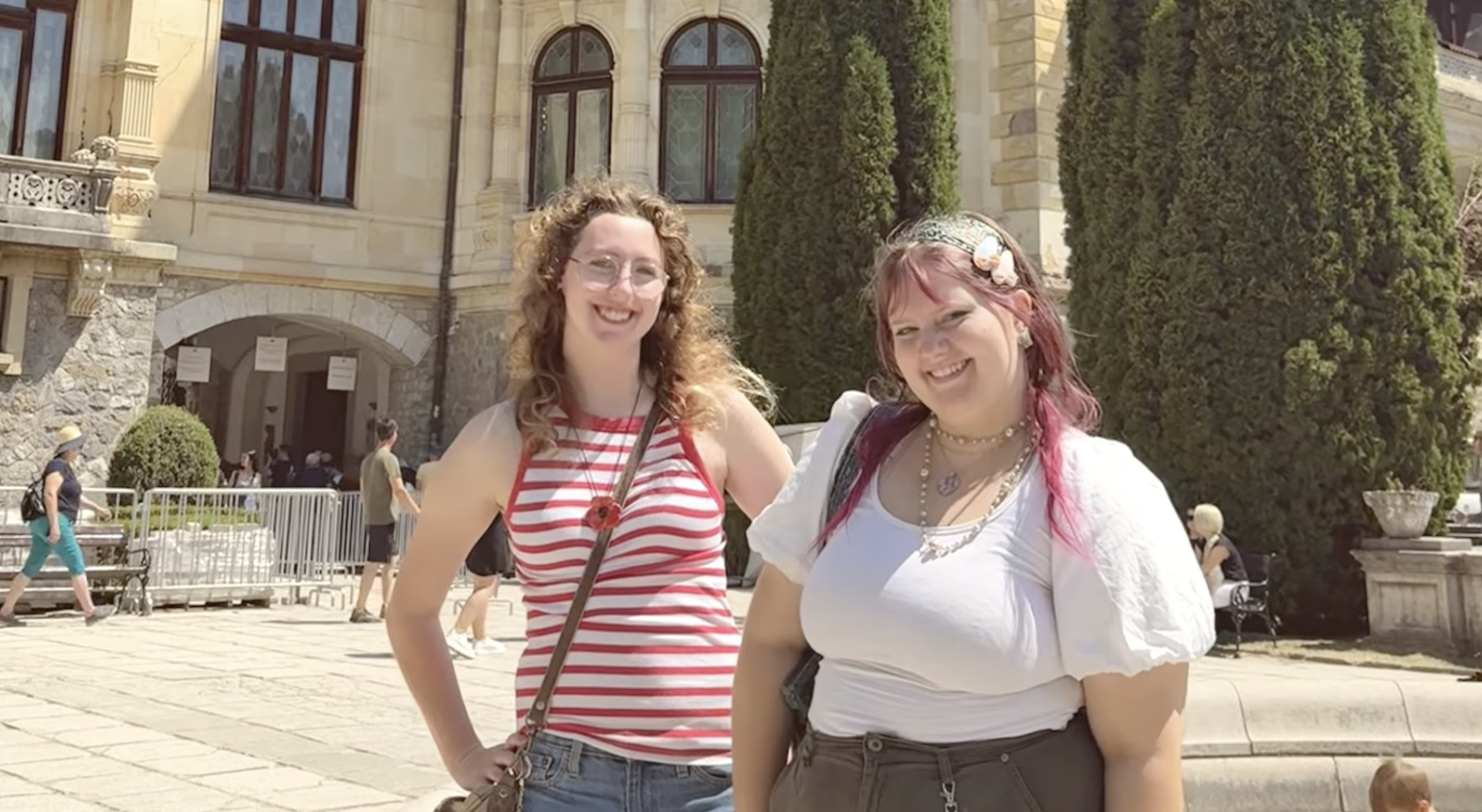
Becca Orjala and Katie Axon were students at Transylvania University in Lexington, Kentucky. Across the Atlantic was another Transylvania: a region of Romania they knew mostly through Dracula, castles and the curious coincidence that it shared a name with their university.
Why not go see it for themselves?
“We just thought it was kind of a funny joke at first,” Orjala said. “And then we realized that we actually wanted to go there.”
For Axon, part of the appeal was precisely that it was unexpected.
“It’s not a touristy place and somewhere not a lot of people go,” she said. “And we like to be different.”
What began as an offbeat idea grew into an opportunity to experience another culture, challenge their creative habits and look at their own work in new ways. With support from a university grant, the two studio art students traveled to Romania. They came home with photographs, journals, new artistic influences and ideas that eventually found their way into original artwork exhibited on campus.
Their journey says something about the kind of education that can happen at Transylvania University. A liberal arts education encourages students to look beyond the obvious, make connections across interests and see possibilities where they might not have been looking. And at Transy, those possibilities are often sparked by personal relationships, conversations with faculty and an environment where students are encouraged to pursue an idea simply because it interests them.
Sometimes, that idea starts with a shared name on a map.
An idea worth pursuing
The Romania trip wasn’t the first time Orjala and Axon had turned an unusual idea into an opportunity.
The year before, art professor Kurt Gohde had encouraged them to pursue a university grant that allowed them to travel to Italy and Greece for an art exhibition they wanted to see. They considered adding Romania to that itinerary, but the plans didn’t come together.
The possibility stayed with them.
Having experienced what university support could make possible, they applied for another grant. This time, Romania became the destination.
For Orjala, the opportunity meant more than a chance to travel.
“The fact that I have a school that’s able to pay for me to travel to these places and get all these experiences that I probably wouldn’t be able to do without them is really special to me,” she said.
The story is about more than funding a trip. It’s about what can happen when students have the freedom to explore an interest and the encouragement to take it somewhere unexpected.
That kind of encouragement can look different for every student. It might begin with a conversation after class, a professor suggesting a resource or a student wondering whether two seemingly unrelated interests could come together. The possibilities aren’t always obvious at first. Sometimes, they take shape because someone knows a student well enough to recognize an opportunity worth exploring.
For Orjala and Axon, that meant taking a shared curiosity and seeing where it could lead.
Discovering Romania beyond Dracula and the castles
Once they arrived in Romania, the students discovered that the most meaningful parts of their trip weren’t necessarily the places that had first captured their imaginations.
Rather than racing from one attraction to another, they spent much of their time in one location, staying long enough to develop routines and become familiar with the people around them.
There was a frozen yogurt shop they returned to and a brunch restaurant where they got to know an Italian waiter who had moved to Romania.
They also noticed that small talk worked differently there, something that became particularly interesting when they began asking people for advice as part of a collaborative art project. Their waiter eventually became one of several people whose words made their way onto a set of oracle cards paired with imagery from the trip.
Everyday interactions became part of the creative process. Getting to know a place meant paying attention not only to what looked different, but also to how people communicated, what mattered to them and how their perspectives might challenge familiar assumptions.
It’s a reminder that broadening a perspective doesn’t always happen through a formal lesson or a planned activity. Sometimes it happens by spending time somewhere unfamiliar, listening to people whose experiences differ from your own and being willing to reconsider what you thought you knew.
For Orjala and Axon, those encounters became the beginnings of new artwork.
Seeing their work differently
Orjala found herself drawn to people making and selling art at local fairs and shops. Sometimes, their work felt remarkably close to her own. Other times, it introduced her to possibilities she might never have considered.
“I would see things and think, ‘I would have made that.’ But someone in a completely different country has made it,” she said.
The realization was both familiar and surprising. Creative ideas can emerge independently across cultures, while encountering another artist’s work can reveal new approaches to materials, composition and technique.
Orjala began buying pendants from Romanian artists to incorporate into her own necklaces, something she hadn’t done before.
“I really like this idea of collaging together different artists to make something brand new,” she said.
Axon collected a different set of visual impressions: folk art, painted eggs, textiles and Gothic imagery.
At Bran Castle, historical displays prompted her to think about women and the treatment of women’s bodies. Elsewhere, she photographed enormous stork nests perched on Romanian rooftops.
One photograph stayed with her in particular. The triangular roof beneath a nest reminded her of a medieval torture device she’d seen at the castle. The unexpected connection between storks, childbirth and that darker history became an idea she wanted to explore through her art.
The two students were looking at the same country, but they were taking away very different things. Their interests, observations and individual perspectives shaped what they noticed and what they wanted to make of it.
That’s part of the richness of studying the liberal arts. Students learn to approach questions from different angles, draw on more than one discipline and recognize that there may be several interesting ways to interpret the same experience.
They don’t have to arrive at the same conclusion. In fact, the different directions they take can be where the most interesting learning happens.
Bringing new perspectives home
Coming home presented a different challenge: How do you make art from a place without simply illustrating where you’ve been?
For Orjala, the answer became more personal than geographic.
She returned to her photographs, videos and journal to understand what had stayed with her. She also reflected on the vulnerability she’d seen in the work of artists in Romania and how it might influence her own practice.
In an installation titled “What Is Love?” she used footage from the trip to explore emotions she normally kept outside her work. She asked people around her what love meant to them and incorporated their responses into the installation.
“I explored these feelings and emotions that I don’t usually put into my work,” she said. “It’s something that I probably would not have had the confidence to put on if I hadn’t gone to this country.”
For Axon, the experience became an opportunity to bring together different parts of her creative life.
Her photography book, “Transylvania, Romania,” layered images from the trip with photographs of herself and friends in Kentucky. Altered colors, lace and drawings made directly on the book helped bring those images together.
“I think that has a lot of different parts of me in it,” she said. “It has my friends. It has a few different passions of mine.”
Both artists eventually shared their work through an exhibition in the Susan B. Shearer Student Art Gallery at Transylvania University, bringing their experiences back to campus.
The exhibition gave their ideas a place to take shape and allowed the university community to encounter Romania through their individual perspectives. What began as a trip had become something the students could interpret, create and share.
And that is an important part of the process: An experience doesn’t have to end when a student comes home. It can become a new project, a different way of approaching a question, an unexpected creative direction or even the starting point for something else entirely.
Room to explore what comes next
For Orjala, the trip expanded what she felt comfortable revealing in her art. For Axon, who had been apprehensive about traveling somewhere unfamiliar, it made the unknown feel like an invitation rather than an obstacle.
“The fun was figuring out Romania while I was there and learning about the people and the place,” Axon said. “Just immersing myself in that place for a few weeks is something I would love to do again, either there or somewhere else.”
Axon is already thinking about where she might go next, drawn to places precisely because she doesn’t know much about them. Orjala returned home considering what she might make next and how much more she might be willing to explore.
Neither could have known what the trip would mean for their work when they first entertained the idea because of a shared name.
That may be the most interesting part of their story. The destination wasn’t predetermined. Neither was the artwork they would create or the things they would discover along the way.
At Transylvania, students are encouraged to bring their own questions, interests and ambitions to their education. Faculty relationships create opportunities for those interests to grow, and the flexibility of a liberal arts education gives students room to make connections they may not have considered before.
The result isn’t one particular path or experience. It’s the chance to discover how many directions an education can take when students are encouraged to think creatively, follow their curiosity and look beyond what they already know.
For Orjala and Axon, that meant traveling halfway around the world to a place with a familiar name and coming home with an entirely different perspective.
One improbable “what if” turned out to be a pretty good place to start.
At Transylvania University, an idea doesn’t have to fit a particular mold to be worth pursuing. Explore studio art at Transylvania University, discover study abroad opportunities and see what can happen when you bring your interests, questions and ideas to a community that encourages you to explore them.