
1780 – The Official Blog of Transylvania University

1780 | The Official Blog of Transylvania University

TransyPods: Learn You a Thing with Dr. Steve Hess

Learn You a Thing Episode 1: Dr. Steve Hess Explains Chinese Politics Listen on Soundcloud Transcript TRISTAN REYNOLDS: Hi. Welcome to the Learn You a Thing podcast. I’m Rambler editor in chief, Tristan Reynolds. In each episode, I’m going to talk to an expert about their expertise, and by the end of it, we’ll all be smarter. This week, Dr. Steven Hess explains politics in China. [MUSIC PLAYING] So I’m here with Dr. Steve Hess who is an expert on Chinese politics. And as a mark of respect for that expertise, I’m going to ask you to explain Chinese politics in 30 seconds from a 3,000 foot level. STEVE HESS: OK. Well, when you’re looking at Chinese politics, you look at the establishment of the People’s Republic of China in 1949. You know, the fact that China functioned as a Communist single party state from then until the present. But that doesn’t really tell you the whole story. We’ve seen China really evolve from Maoism from 1949 all the way up to 1976, which you had a totalitarian state, mass campaigns. People lived and breathed politics. You know, the party was really intrusive and controlled every part of your life up until the late 1970s in which China has maintained that same single party political structure, but has implemented market reforms. And so we still have this same basic political structure in which you have a single party state led

Transylvania University Dean’s List for Fall 2017

Congratulations to all students who made the Transylvania University dean’s list! Announcements of your achievements have been sent to your hometown newspapers.   A – C D – H I – L M – P Q – T U – Z A Nadine Abul-Khoudoud Sarah Agard Ana Aguilar Sameer Ahmed Ty Alderman Tipton Alexander Erin Alexander Isabella Alonso-Minter Mary Grace Amato Drew Angel Sarah Ashley B Evan Baber Lydia Baggett Timothy Baker Rylan Banks Madison Banta Sami Barefield Kailee Bartel Lindsey Barton Isaac Batts Greg Baunach Lauren Beams Sarah Bennett Jack Berger Tim Bickel Sara Bidarian Scarlett Bilbro Jackson Bishop Abby Blackburn Rebecca Blankenship Lindsay Bloom Faith Boles Aaron Botts Mya Bowen Adrianna Bowman Jewell Boyd Shelby Boyle Riley Bresnahan Caroline Briggs Grayson Briggs Sydney Brookshire Cabby Brown Bailey Browning Kira Bruno Kearstin Bruther Ally Brutscher Bayley Brutscher Jennifer Buckman Kaitlyn Buechel Eileen Bunch CJ Burton Alyssa Bustle C Jake Cahill Maddie Campbell Mary Campbell Stevee Candrl Cate Caperton Brody Carpenter Rachel Carpenter Kaili Carson Emily Chapman Hudson Chastain Heaven Chen Nanhao Chen Alex Cherry Ruth Choate Catherine Clark Kelsey Clater Carlee Clemons Kaitlyn Collins Matt Colwell Darrell Corn Brandon Couch Marissa Coutinho Candace Cox Jeremiah Cox Max Crabtree Madison Crader Gabrielle Crooks Abby Cullen Delaney Cullen Jessica Curry D London Dailey Laura Daley Zachary Day Garrett Dean Elizabeth Deaton MacKenzie Dent Emily Dent Drew Dodds Ashley Dragan Makayla Dublin Rebecca Duff Jordan Dunaway Jonathon Dunaway Chelsea Dunaway E Julia

TransyPods: Interview with Dr. Bethany Packard

Tristan Reynolds ’19 in conversation with Dr. Bethany Packard about her focus on the early modern period of English literature. Listen on Soundcloud Transcript SPEAKER: Welcome to another Campus Conversation– Discussions with Transylvania University Faculty, highlighting their interest, passions, and pursuits. Here is Tristan Reynolds. TRISTAN REYNOLDS: I’m here with Dr. Bethany Packard who is an English professor here at Transy, focusing on the early modern period of English language literature. What is that, exactly? BETHANY PACKARD: The early modern period and what people consider it to be can vary depending on your discipline. As I’ve, for example, if I were in French literature or history, I might extend the time period a little later. So in English literature, the early modern has come to be the standard term that’s used often for 16th and 17th century literature. It’s sort of become the replacement for the Renaissance. So before I entered graduate school, in the past, the more common term– and a term that’s still used quite a lot interchangeably with early modern– is Renaissance when you’re talking about the English Renaissance. Of course, the people who work on Italian and even some northern European folks might differ with that. But over time, that term has shifted. But if I were working in, like I said, something like French literature, I might extend that into the 18th century or I might extend it a little bit earlier. So it’s kind

Business as Unusual

Pioneers Never Settle Whether it’s ride-sharing or mixology or apparel, students are making their way into a huge variety of fields in a fluctuating job market. What is it about Transylvania that encourages its graduates to find success in arenas that are not always in line with their degrees? Why won’t these students settle for business as usual? You’re sitting in the middle of a pristine lake, surrounded by evergreen trees and picturesque, snow-capped mountains. Look up, and the red-orange sky begins to turn a vivid blue; look down, and you can see a school of fish nipping at the surface of the calm water. To your right, you hear the sound of a train chugging around the perimeter of the lake, a long trail of black and gray smoke following behind. As you watch it move steadily past, it begins to turn left, making its way impossibly toward the water and toward you. Suddenly it hits the shoreline, kicking up a huge wake and picking up speed as it comes directly your way. You start to look around, wondering if you should move or whether this is just a trick of the imagination. As the engine gets closer, your pulse quickens—it’s right on you—and as you brace for the impact, the train explodes into a flock of birds, darting past you in an overwhelming swarm. You have just had your first experience with the awe-inducing, sometimes disorienting, technology of virtual reality.

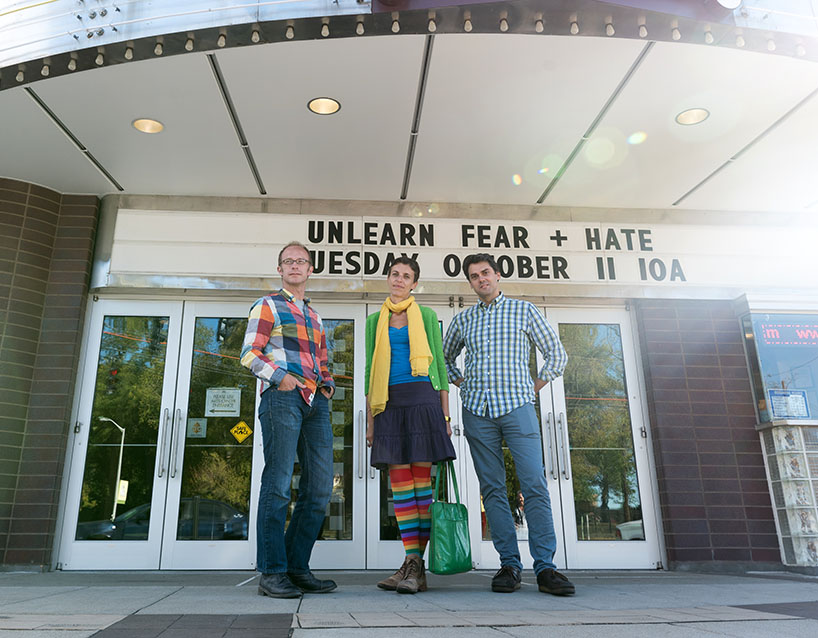
Unlearn Fear + Hate

An Intervention Into the LIfe of a City Through Art Professors Kurt Gohde and Kremena Todorova have ventured from the corner of Third and Broadway to create art projects that are far from what you might associate with Transy. Their new project, Unlearn Fear + Hate, also takes shape off campus—for instance, as a metal halo bearing the message attached to the 21c Museum Hotel in downtown Lexington. But the saying was so powerful and timely that Transylvania incorporated it into the very fabric of this academic year—from endowed lectures to an embroidery project. Todorova, associate professor of English, didn’t want unlearn fear and hate to become just words that students occasionally heard about something going on “out there”—a noble idea, of course, but not terribly meaningful to them. Gohde, professor of art and chair of the Fine Arts program, was on board with that. “We’ve never done anything where the whole campus community was involved, and that was a really exciting idea,” he said. The theme ties into a dialog happening on the national level—and into the university’s overall calling, said Laura Bryan, vice president for academic affairs and dean of the university. “These conversations and activities are consistent with the mission of the liberal arts education.”  Jeremy Paden, associate professor of Spanish and Foreign Languages program director, is helping thread Unlearn Fear + Hate through Transylvania’s academics. This effort raises important questions. “As an institute of higher learning,