

If you try to picture what an excise tax class might look like, students sitting at their desks, poring over dense rate schedules and regulations might come to mind. For recent Transylvania grad Katie Shaffer, however, it meant a memorable journey through Europe exploring how other countries tax “harmful goods.”
“What started as a class on excise taxes quickly became something so much bigger than we could have imagined,” said Shaffer, a business administration major from Richmond.
Transylvania University’s four-week May term is a time for students to take advantage of study abroad, especially if they just want to try it out. Typically team-taught and interdisciplinary, these courses blend academics and travel with familiar faces.
“It’s a good option for students who haven’t been abroad before and who want to go with a group of students and faculty that they know,” said Rachel Wilson, director of global and intercultural engagement.
Shaffer’s course, “Excise Taxes on Harmful Goods: An Ethical and Financial Perspective,” taught by professors Jeff Hopper and Christi Hayne, linked Kentucky’s tobacco, alcohol and racing heritage to international policy and business practices. Students first visited local distilleries, wineries, breweries and Keeneland, and then spent two weeks exploring European production methods, economies and culture. They wandered medieval cities, hiked mountaintops, toured windmills and celebrated at Frühlingsfest Fest in Munich, where Shaffer joined locals wearing traditional clothing.

“Every city became our classroom,” she said. The experience delivered new perspectives and connections impossible to gain from textbooks alone.
Other May term courses offered similar experiences. “Medical Traditions: East and West,” co-taught by Chinese language and culture professor Qian Gao and philosophy and classics professor David Kaufman, invited students to compare ancient Chinese and Greco-Roman healing practices with modern Traditional Chinese Medicine. The course took a comparative approach to the philosophical foundations of health, disease and wellness in both traditions, exploring their continuing relevance amid today’s growing interest in alternative medicine.
Students engaged primary texts from the Hippocratic Corpus, Galen and Plutarch on the Western side, along with the “Inner Canon of the Yellow Emperor” and the “Tao Te Ching.” Before traveling, the class visited the library’s Special Collections, where they explored early editions of Galen and Hippocrates — as well as the first English-language book translation on acupuncture, completed in 1825 on the recommendation of a Transylvania physics professor. This rare artifact highlights the university’s historic ties to global medical knowledge.
The group then spent 11 days in Seattle, Vancouver and Victoria (top photo). Students attended classes, visited traditional Chinese herbal shops and museums and immersed themselves in the region’s distinctive wellness culture.

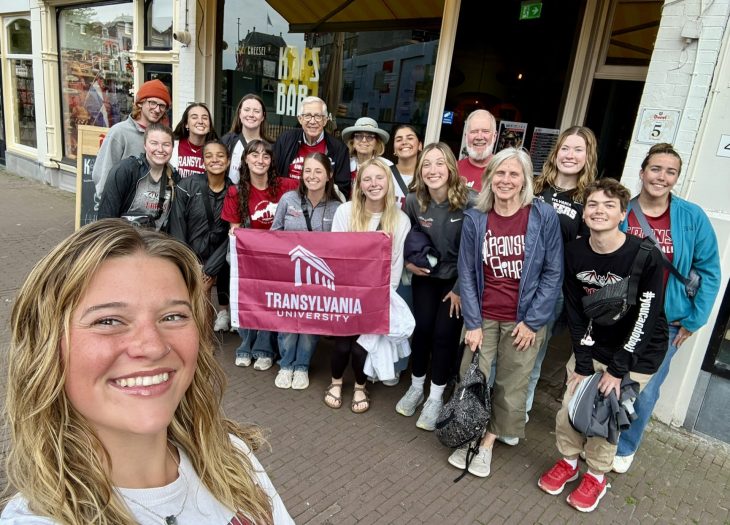
Additionally this May term, some of the other study abroad classes included a Renaissance course that took students to Italy and France to examine the rebirth of human thought. Another group studied Scotland’s climate change efforts through readings, artwork and direct conversations with locals (above photo). Also, the Public Policy and the Culture of Health in the Netherlands (below) went on a 10-day cycling trip.
Past May terms have sent students beside lava flows in Hawaii, on service projects in the Philippines and to museums and archaeological sites across China.
Transylvania encourages every student to travel abroad at least once during May term. The program combines focused study with cultural immersion in a supportive group—giving students perspectives that last long after graduation.