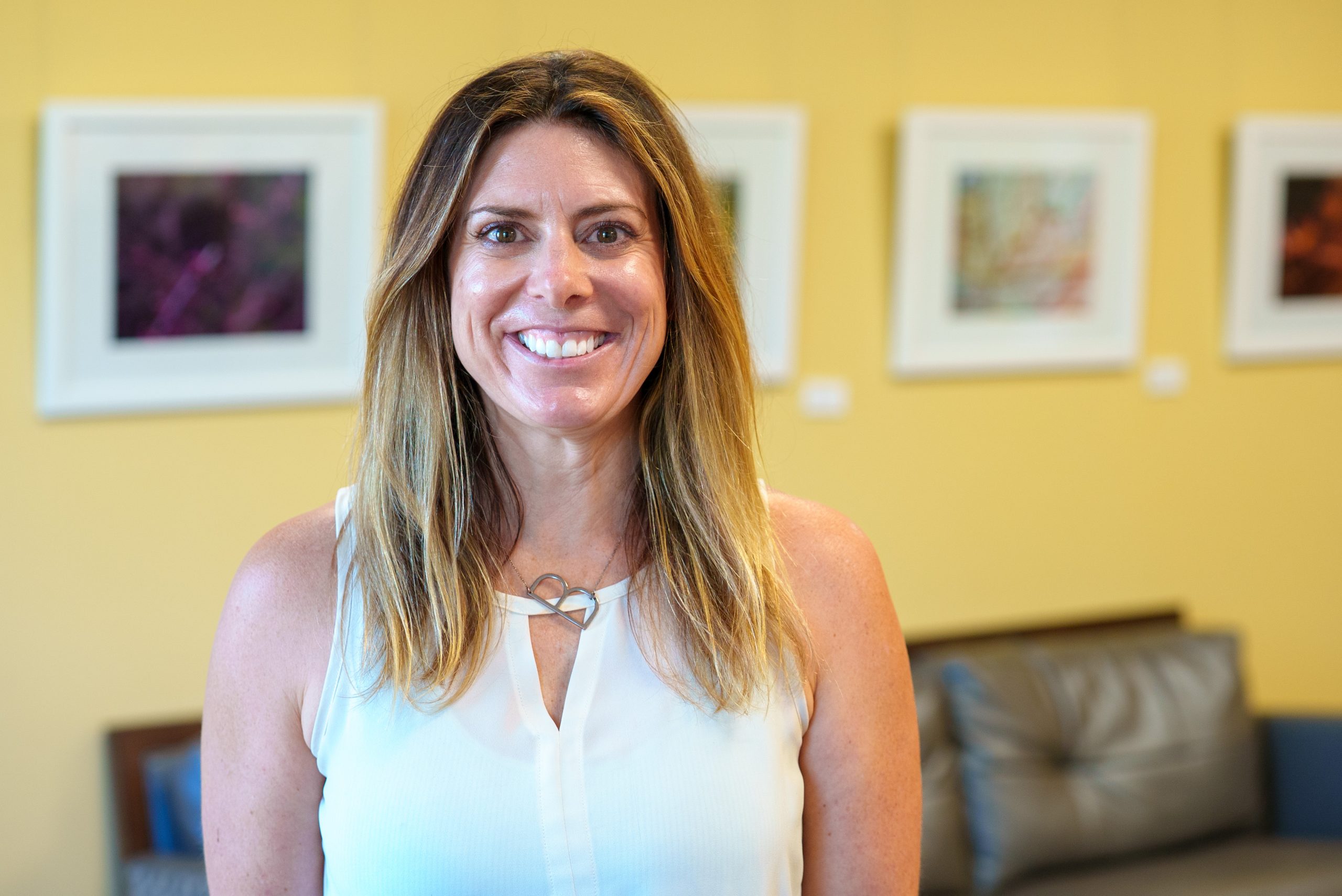
Professor of Psychlogy and Neuroscience
Teaching excellence in my class actually looks messy. It’s unscripted. It’s dynamic. It goes where the students are asking it to go.
Bethany Jurs
Professor of Psychology and Neuroscience
and Bingham Endowed Chair

About Bethany Jurs’ Work
For Bethany Jurs, psychology and neuroscience offer a way of understanding both the individual and the larger systems that shape human behavior.
“I want students to see how this impacts them on the individual level,” she says, “but also how they can extrapolate it to the larger societal level.” In her courses, scientific concepts become a lens that connects personal experience with broader social questions.
Her classroom reflects that approach.
“It’s unscripted. It’s engaging. My goal is that students walk away thinking, ‘I never thought about it like that before.’”
Jurs creates those moments by placing students within the work itself. They design experiments, collect data, and pursue questions that emerge in real time.
“I’m a big proponent of not just talking about a study,” she says, “but actually getting in there. Let’s do it.”
In that process, students begin to see their own ideas differently.
“The types of questions students ask are just as valid as the questions any scientist asks.”
They are not simply learning about the field. They are participating in it.
That perspective is grounded in the interdisciplinary structure of neuroscience at Transylvania, where psychology, biology, and computer science intersect. Students are asked to think across those boundaries, to analyze, question, and communicate complex ideas with clarity.
Just as central is the mentorship that shapes their experience. Having studied at a large university, Jurs understands the difference between being present and being known.
“The amount of attention and connection you get from being a known person to your professor is something that is irreplaceable,” she says. “You are somebody who that professor is mentoring.”
For Jurs, that sustained engagement defines teaching excellence, not only what students learn, but how they come to see themselves: as thinkers, as contributors, and as participants in a larger intellectual community.