1780 – The Official Blog of Transylvania University

1780 | The Official Blog of Transylvania University

TransyPods: Interview with Dr. Bethany Packard

Tristan Reynolds ’19 in conversation with Dr. Bethany Packard about her focus on the early modern period of English literature. Listen on Soundcloud Transcript SPEAKER: Welcome to another Campus Conversation– Discussions with Transylvania University Faculty, highlighting their interest, passions, and pursuits. Here is Tristan Reynolds. TRISTAN REYNOLDS: I’m here with Dr. Bethany Packard who is an English professor here at Transy, focusing on the early modern period of English language literature. What is that, exactly? BETHANY PACKARD: The early modern period and what people consider it to be can vary depending on your discipline. As I’ve, for example, if I were in French literature or history, I might extend the time period a little later. So in English literature, the early modern has come to be the standard term that’s used often for 16th and 17th century literature. It’s sort of become the replacement for the Renaissance. So before I entered graduate school, in the past, the more common term– and a term that’s still used quite a lot interchangeably with early modern– is Renaissance when you’re talking about the English Renaissance. Of course, the people who work on Italian and even some northern European folks might differ with that. But over time, that term has shifted. But if I were working in, like I said, something like French literature, I might extend that into the 18th century or I might extend it a little bit earlier. So it’s kind

Business as Unusual

Pioneers Never Settle Whether it’s ride-sharing or mixology or apparel, students are making their way into a huge variety of fields in a fluctuating job market. What is it about Transylvania that encourages its graduates to find success in arenas that are not always in line with their degrees? Why won’t these students settle for business as usual? You’re sitting in the middle of a pristine lake, surrounded by evergreen trees and picturesque, snow-capped mountains. Look up, and the red-orange sky begins to turn a vivid blue; look down, and you can see a school of fish nipping at the surface of the calm water. To your right, you hear the sound of a train chugging around the perimeter of the lake, a long trail of black and gray smoke following behind. As you watch it move steadily past, it begins to turn left, making its way impossibly toward the water and toward you. Suddenly it hits the shoreline, kicking up a huge wake and picking up speed as it comes directly your way. You start to look around, wondering if you should move or whether this is just a trick of the imagination. As the engine gets closer, your pulse quickens—it’s right on you—and as you brace for the impact, the train explodes into a flock of birds, darting past you in an overwhelming swarm. You have just had your first experience with the awe-inducing, sometimes disorienting, technology of virtual reality.

Unlearn Fear + Hate

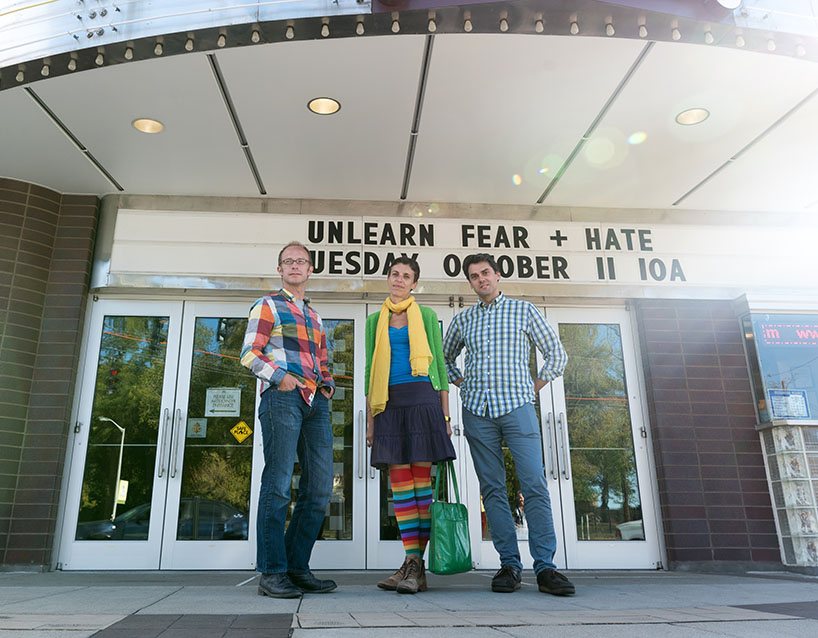
An Intervention Into the LIfe of a City Through Art Professors Kurt Gohde and Kremena Todorova have ventured from the corner of Third and Broadway to create art projects that are far from what you might associate with Transy. Their new project, Unlearn Fear + Hate, also takes shape off campus—for instance, as a metal halo bearing the message attached to the 21c Museum Hotel in downtown Lexington. But the saying was so powerful and timely that Transylvania incorporated it into the very fabric of this academic year—from endowed lectures to an embroidery project. Todorova, associate professor of English, didn’t want unlearn fear and hate to become just words that students occasionally heard about something going on “out there”—a noble idea, of course, but not terribly meaningful to them. Gohde, professor of art and chair of the Fine Arts program, was on board with that. “We’ve never done anything where the whole campus community was involved, and that was a really exciting idea,” he said. The theme ties into a dialog happening on the national level—and into the university’s overall calling, said Laura Bryan, vice president for academic affairs and dean of the university. “These conversations and activities are consistent with the mission of the liberal arts education.”  Jeremy Paden, associate professor of Spanish and Foreign Languages program director, is helping thread Unlearn Fear + Hate through Transylvania’s academics. This effort raises important questions. “As an institute of higher learning,

Transylvania University Dean’s List for Winter 2017

Congratulations to all students who made the Transylvania University dean’s list! We encourage you to submit an announcement of your achievement to your hometown newspaper. Download the press release template below, insert your information in place of the items in parentheses and send the release to your local news organization with attn: newsdesk. Press Release Template   A – D E – H I – L M – P Q – T U – Z A Gage Abell Will Adams IV Megan Aebersold Sarah Agard Ana Aguilar Tipton Alexander Erin Alexander Mary Grace Amato Drew Angel Ciana Applegate Sarah Ashley Jared Auton B Evan Baber Timothy Baker Rylan Banks Madison Banta Sami Barefield Rob Barnes Lindsey Barton Greg Baunach Lauren Beams Gage Beavers Eden Bennett Jack Berger Olivia Beutel Tim Bickel Sara Bidarian Carrie Billett Sylvie Biruta Jackson Bishop Abby Blackburn Connor Blevins Olivia Bloemker Lindsay Bloom Taylor Bloomhuff Darby Bourdon Mya Bowen Adrianna Bowman Jewell Boyd Shelby Boyle Anna Rose Brailow Katie Brewer-Calvert Sydney Brookshire Cabby Brown Bailey Browning Elyse Brumfield Judy Brumley Kira Bruno Kearstin Bruther Mattie Bruton Ally Brutscher Bayley Brutscher Christa Brutscher Corbyn Buchart Jennifer Buckman Lucas Bundy Michael Burns Jr. CJ Burton C Jake Cahill Chase Caldwell Alanna Campbell William Campbell Rob Canady Stevee Candrl Claudia Carc mo Kelli Carpenter Brody Carpenter Kellen Casey Shelby Catlett Alex Cesar Jessica Chandler Emily Chapman Ellis Chase Heaven Chen Pound Chen Blake Chidester Catherine Clark Kelsey Clater Carlee Clemons

TransyPods: Interview with Dr. Avery Tomkins

Griffin Cobb chats with Bingham Diversity Scholar, Dr. Avery Tompkins about his research on gender and how it relates to issues at TU. Listen on Soundcloud Transcript [MUSIC PLAYING] SPEAKER 1: Welcome to another Campus Conversation, discussions with Transylvania University faculty, highlighting their interests, passions, and pursuits. Here is Griffin Cobb. GRIFFIN COBB: I’m here with Dr. Avery Tompkins, who is the Bingham Diversity Scholar and an assistant professor of sociology here at Transylvania. And we’re going to talk about the role of gender at Transy as well as his research into gender in general. So the first thing I want to ask is, how do we define gender, and how should we? AVERY TOMPKINS: OK, so I think that this is a question that’s difficult to answer. So people in general would probably say that gender is social– there’s a social aspect to that– and that it encompasses things like how people see their own sense of self and then also how others perceive them. So people may choose their gender or feel that they are a gender that might be man, or woman, or trans, or genderqueer, or some other gender that probably people would loosely put under transgender, even if people do not necessarily use that word to describe themselves. But in general, gender’s just how people feel about themselves and then also how people perceive them. Usually, gender– like for cisgender people, non-transgender people– it’s like