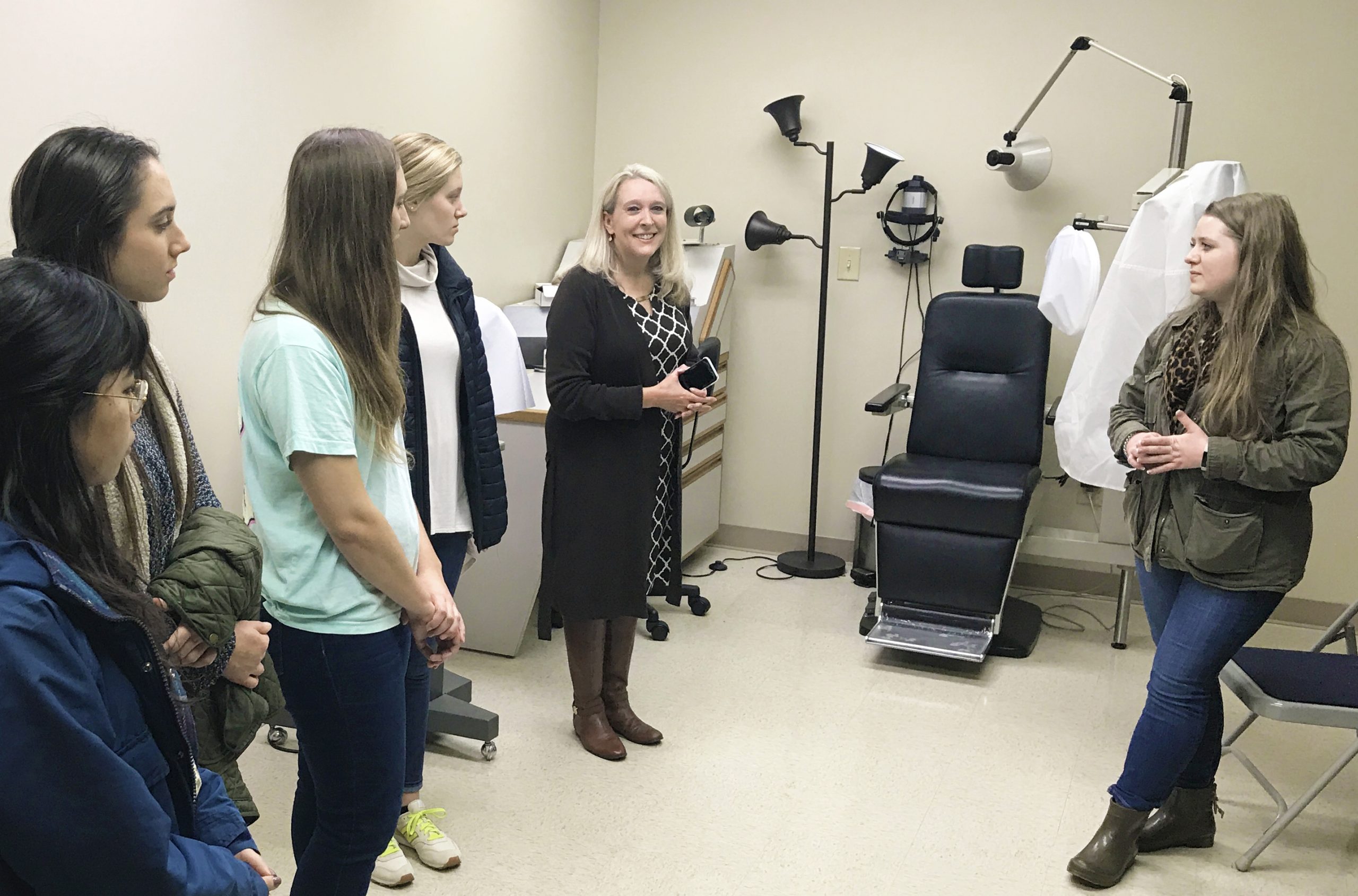
From professional advice to community engagement, Pre-Health Week just what doctor ordered
Transylvania University pre-health students ventured beyond their classrooms and labs this week to learn about real-world opportunities.
1780 – The Official Blog of Transylvania University

Transylvania University pre-health students ventured beyond their classrooms and labs this week to learn about real-world opportunities.
Transylvania recently installed an electroencephalogram system to record brain data—bringing the school on par with many of the nation’s prestigious research institutes and university neuroscience labs.
Transylvania’s theater season kicks off Nov. 1 with an irreverent, contemporary, and very funny remix of Chekhov’s The Seagull by playwright Aaron Posner.
Transylvania in Ireland includes courses taught by the university’s faculty along with local and regional experts in folklore, writing, music and dance.
LEXINGTON, Ky.– Transylvania University’s 2018-19 theater season will feature four productions—from the contemporary to Shakespeare—under the leadership of Tosha Fowler, the new Lucille C. Little Chair of Theater and program director. All productions will be in Little Theater and are free to the public thanks to the generous support of the Dixon-White Fund. Transylvania Theater will benefit from Fowler’s extensive professional career in theater as an actor, director, producer, teacher and playwright in both Chicago and Atlanta. Hailed as the “fearless leader” of her founding company, Cor Theatre, she was named “One of the Top People Who Really Perform” by Newcity Chicago. Additionally, Fowler has taught at The Theatre School at DePaul University, Kent State University, Green Shirt Studios and Georgia Southern University. “I could not be more excited to join the Transy faculty and to work with the Lexington theater community,” Fowler said. “It is an exciting time to create theater in this thriving city, and I am ready to get to work. I plan on collaborating with local talent and bring in colleagues from across the country to enrich the Transylvania Theater experience.” From Nov. 1-10, Fowler will direct a production of “Stupid F—ing Bird,” a heartfelt, irreverent remix of Chekhov’s “The Seagull” by Aaron Posner. Featuring an ensemble of writers, actors and those who choose to watch, it will tickle, tantalize and incite the audience to consider how art, love and revolution fuel the pursuit of happiness. On
Read “New program director leads Transylvania Theater’s 2018-19 season”