
Students are often surprised to learn that entrepreneurship can be learned by anyone, not just those who want to own a business.
Some of the best business leaders and C-suite executives operate with an entrepreneurial mindset but do not take on the same level of financial risk as a founder. Entrepreneurship is not limited to startup culture or television pitches. It is not just “Shark Tank” million-dollar ideas. It is restaurants, bakeries, event companies, bookkeepers and clothing shops. It is local. It is practical. And it is hard work.
What surprises most people about entrepreneurship and business ownership is how difficult it can be. Building something from the ground up requires persistence, adaptability and a willingness to learn constantly. It is not easy, but it is deeply worth it.
Entrepreneurship connects to every career path
Learning the facets of entrepreneurship prepares students for virtually any career field.
Students learn the basics of accounting and finance by reading a profit and loss statement and understanding the costs of goods and services. They explore marketing and promotion strategies that every organization needs to thrive. They examine company culture, human resources and staffing practices that determine whether a business succeeds long term.
This cross-training makes students more competitive and more adaptable in the workforce. Even if they are not yet the manager or owner, they understand how decisions affect the entire organization. They see how the pieces connect. That perspective makes them more valuable employees and stronger leaders.
Entrepreneurship education is not just about starting a company. It is about learning to think strategically, evaluate risk and identify opportunity in any setting.
Building a business from the ground up in BA 3244
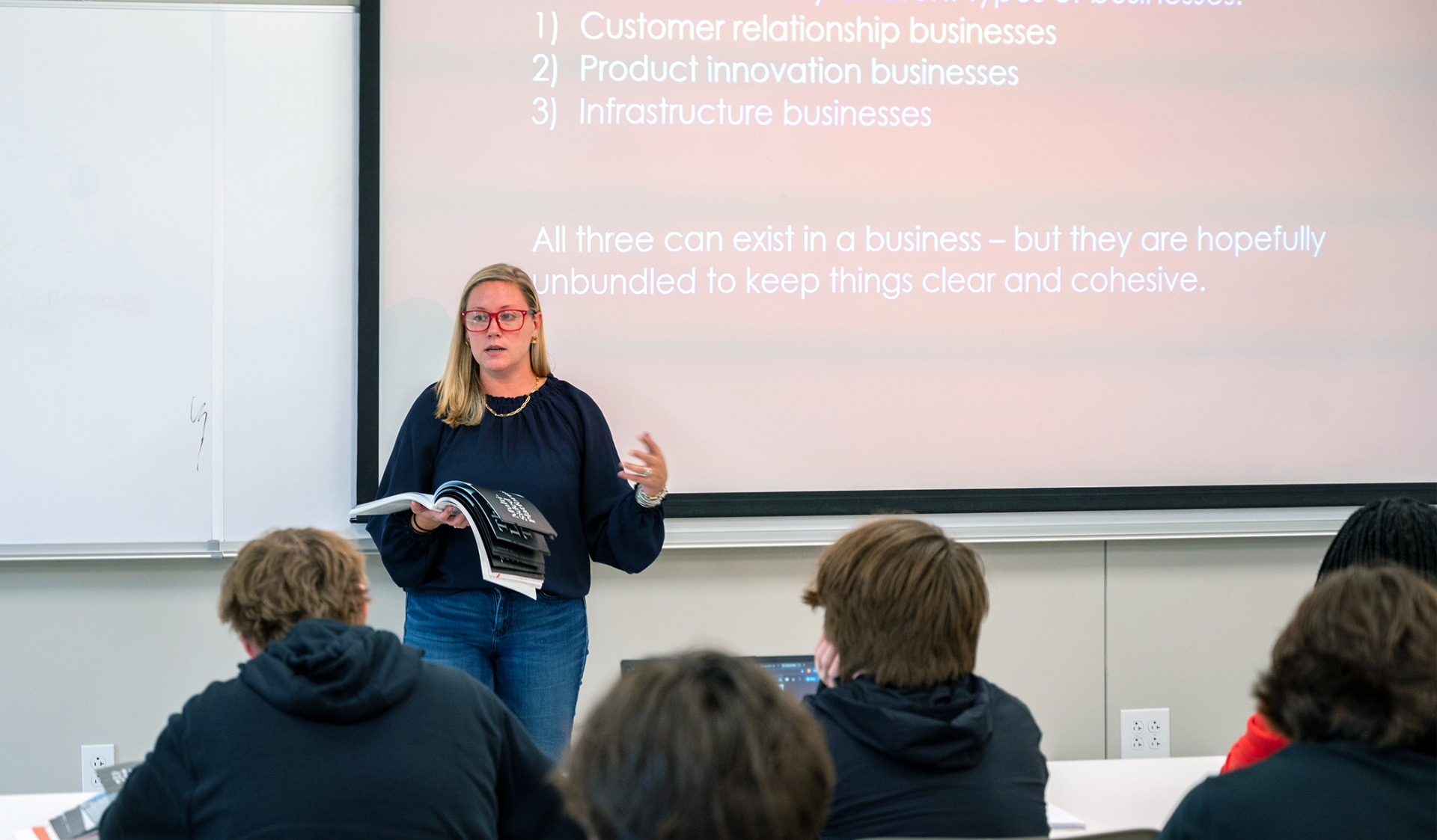
In BA 3244, Entrepreneurship, students create a business plan around a company they are tasked with developing. This process pushes them beyond their traditional major trajectory and challenges them to think holistically.
When students work through the stages of building a company, they begin to see why every decision matters. They understand why the name matters when they move into the marketing phase. They see how each operational piece affects sales and ultimately the bottom line. They recognize why business structure matters when comparing the cost of large buildings and offices versus keeping a company small or remote.
By the end of the course, students have a much deeper understanding of how a full business operates. They gain an appreciation for every function within an organization, not just their individual role. No matter what industry or sector they pursue after graduation, they leave with a broader perspective and a stronger foundation.
Why a liberal arts education strengthens entrepreneurship
A liberal arts approach to learning makes students better prepared for business and business ownership.
When students study across disciplines, they develop a wider lens. They encounter communication strategies, business administration principles, finance concepts, marketing frameworks and psychology insights. Each area contributes to their ability to understand people, markets and organizational dynamics.
Business owners, especially in the early stages, wear many hats. They manage finances, oversee marketing, handle staffing, shape culture and communicate vision. A broad educational foundation provides a clear advantage when stepping into those responsibilities.
At Transylvania University, entrepreneurship is not taught in isolation. Through the Center for Entrepreneurship, students test ideas, build ventures and connect classroom theory to real-world execution. They gain experience that translates directly into internships, leadership roles and career advancement.
When I think about why I chose to come to Transylvania to teach and grow the Center, it comes down to the opportunity to build something meaningful from the ground up. I have always been drawn to the earliest stages of an idea — that moment when anything feels possible — and the chance to help relaunch the Center for Entrepreneurship felt like a natural extension of my work as an entrepreneur. What excited me most was the ability to work with students across all majors because, at a place like Transy, entrepreneurship is not limited to business; it is a mindset rooted in curiosity, creativity and problem-solving. I was also energized by the momentum on campus and within Lexington’s broader business community, as well as the opportunity to connect a liberal arts education with real-world experience. Ultimately, I chose to be part of Transylvania because it aligns with how I see entrepreneurship: not just as starting companies, but as a way of thinking, taking initiative and helping students build something that matters from the very beginning of their journey.
Entrepreneurship is not just about owning something. It is about building something meaningful, understanding how systems work and having the confidence to step forward with an idea and make it real.
Start building real-world-ready skills
If you want more than a classroom experience, explore the Center for Entrepreneurship at Transylvania University. Through hands-on projects, business plan development, mentorship and community partnerships, students gain practical skills that employers value and founders rely on.
Learn how you can build career-ready confidence and real-world experience.
About the author
Kaelyn Query is director of the Center for Entrepreneurship and adjunct instructor of Entrepreneurship at Transylvania. She works with students across majors to develop entrepreneurial thinking, practical business skills and innovative solutions that connect classroom learning with real-world opportunity.