Families deserve honest answers about what a college experience will mean for their student.
When you ask what a Transy degree leads to, you are not asking for a slogan. You are asking whether your student will be prepared for professional school, competitive careers and long-term growth.
At Transylvania University, preparation is structured. It is mentored. It is experiential. And it is grounded in a liberal arts framework that builds both expertise and adaptability.
Below are clear examples of how pre-med, pre-law and computer science and engineering pathways translate into real outcomes.
Academics at Transy: Flexible majors, meaningful minors, tailor-made pathways
Before focusing on specific pathways like pre-med, pre-law or computer science, it helps to understand how academics are structured at Transylvania University.
Transy offers more than 45 majors and minors across the humanities, social sciences, natural sciences and emerging interdisciplinary fields. Students are encouraged to explore widely before declaring a major, and many choose to combine a major with one or more minors to create a pathway that reflects their interests and career goals.
This flexibility is intentional and the result is a personalized education. Small classes, accessible faculty, individualized advising, internships and mentorships allow students to shape academic plans that reflect both intellectual curiosity and professional ambition. Interdisciplinary study is a strength of Transylvania, not an exception.
A biology major might add a minor in Spanish to strengthen communication with diverse patient populations. A computer science major might minor in philosophy or ethics to deepen understanding of artificial intelligence and its societal impact. A political science major preparing for law school might add economics or writing to broaden analytical and persuasive skills.
Families can explore all majors and minors here.
Family takeaway: A Transy degree is not a narrow track. It is a customizable framework that allows students to combine depth in a major with breadth through minors and experiential learning. That combination builds adaptability, which is one of the most valuable traits in today’s evolving workforce.
Pre-health pathway: Structured support and strong outcomes
Transy’s pre-health preparation is comprehensive and personal.
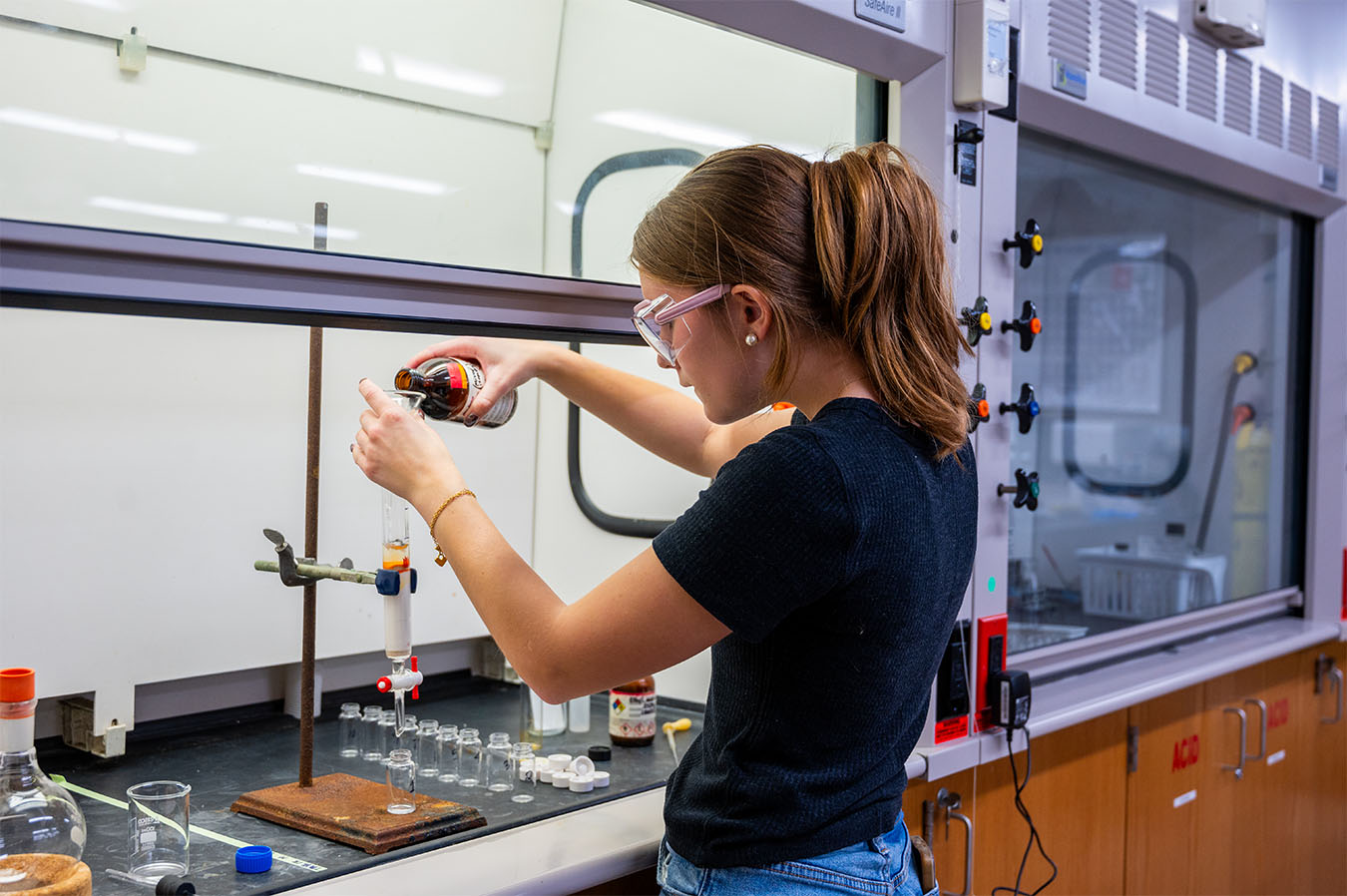
Students begin advising early. They build academic plans that integrate medical school prerequisites with a chosen major. They participate in workshops focused on personal statement development, resume preparation and mock interviews. Transy also provides committee recommendation letters, a critical component of competitive medical school applications.
Pre-health students are encouraged to engage in shadowing, volunteer service, research and participation in organizations such as the Pre-Health Club and Phi Delta Epsilon medical fraternity.
The results reflect the preparation. Approximately 90 percent of Transy students recommended to health professional schools are accepted. Nationally, medical school acceptance rates hover near 50 percent. That difference speaks to advising depth, academic rigor and experiential preparation.
Students like Ethan Lawhorn illustrate how this works in practice. As a biology major, he combined scientific coursework with data analysis skills using R and completed research at Cincinnati Children’s Hospital. His goal is to pursue both medical and legal education, integrating clinical practice with ethical systems.
Family takeaway: Pre-health at Transy is not just prerequisite completion. It is scientific rigor paired with communication skills, mentorship and clinical exposure that position students for competitive admission and long-term success.
Pre-law pathway: Mentored preparation for legal and civic leadership
Transy’s pre-law program emphasizes interdisciplinary preparation and individual mentoring.
Students can major in any discipline while building the analytical reasoning, ethical judgment and persuasive communication skills law schools demand. Faculty advisers guide students through LSAT preparation, application strategy and school selection.
Participation in organizations like Phi Alpha Delta and engagement in speech and debate activities provide practical training in argumentation and public speaking. These experiences mirror the skills students will use in legal practice.
Transy graduates have been admitted to highly selective law schools including Harvard, Duke, Stanford and Cornell, among others. That record reflects the combination of intellectual rigor and personalized support.
Valerie Whitlock McCubbin ’15 represents what this path can lead. She now practices law with Claycomb Law Office PLLC and serves as counsel to the LaRue County School Board. Her career reflects how a liberal arts foundation can translate into legal leadership in both private practice and public service.
Family takeaway: Pre-law at Transy builds disciplined thinkers and ethical advocates. The program is less about a checklist and more about cultivating the reasoning and communication skills that define successful attorneys.
Computer science: A long history, a future focus
Transy’s computer science program is one of the oldest undergraduate computer science programs in the country, with courses dating back to 1966 and a formal major established in 1969.
The curriculum integrates foundational computing principles with opportunities in robotics, artificial intelligence, software engineering and applied project work. Students complete senior projects that require both technical depth and communication clarity.
Christine Lee ’20 demonstrates how that preparation translates into career opportunity. After changing her major to computer science, she completed an internship in automation engineering at Gray Solutions in Lexington and moved into a full-time automation specialist role following graduation.
Transy alumni have also built careers at Microsoft, Humana and Lexmark, and in cybersecurity roles with Brown-Forman. Some have pursued advanced graduate study, including a 1991 graduate who earned a Ph.D. in computer science at Georgia Tech, researching artificial intelligence before returning to Transy to teach.
More recently, alumni have moved into robotics companies and AI-focused firms such as AssemblyAI. These paths demonstrate that a liberal arts computer science education can compete and thrive in cutting-edge technology spaces.
Family takeaway: Computer science at Transy combines technical skill with the communication, ethical reasoning and adaptability required in AI-driven industries. Graduates are prepared not only to code, but to lead and innovate.
Engineering preparation: a bridge to advanced technical study
For students considering engineering, Transy’s pre-engineering pathway allows students to complete foundational coursework before transferring to partner engineering institutions for specialized degrees.
This approach gives students the benefit of small classes and close faculty mentorship during critical early coursework in mathematics and science. It also provides flexibility for students who want both technical rigor and a liberal arts foundation before entering highly specialized engineering programs.
Family takeaway: Pre-engineering at Transy supports strong preparation in mathematics, physics and analytical reasoning while preserving the broad skill development that strengthens long-term leadership in technical fields.
The liberal arts advantage in an AI economy
Across fields, employers consistently prioritize problem-solving, teamwork and communication alongside technical knowledge. The difference between a technician and a leader often lies in the ability to explain complex ideas, collaborate across disciplines and think ethically about impact.
Transy integrates these competencies through internships, faculty mentorship and alumni engagement coordinated by the Center for Academic and Professional Enrichment. Programs such as 100 Doors to Success connect students with alumni mentors early, building networks and professional confidence.
That structure ensures majors are not isolated silos. They are launching points.
Honest advice for families
If you are evaluating pre-med, pre-law or computer science pathways, ask specific questions.
What acceptance or placement data is available?
What experiential learning is required?
Where have recent graduates landed?
At Transy, the answers include medical school acceptances at above-national rates, admissions to top law schools, alumni success in AI and robotics, and graduates who return to teach the next generation.
A Transy degree leads to more than a first job. It leads to capability and confidence. Ultimately, a Transylvania degree prepares graduates to be real-world ready.
See it for yourself
The best way to understand how a major becomes a pathway is to speak directly with faculty and students. The question is not simply where a degree begins, but where it can take your student next.
Schedule a visit to campus and explore programs in pre-health, pre-law, computer science and engineering preparation.