Transylvania University’s theater program will bring myth, movement and powerful visual storytelling to the Little Theater this spring with Mary Zimmerman’s “Metamorphoses,” directed by Tosha Fowler.
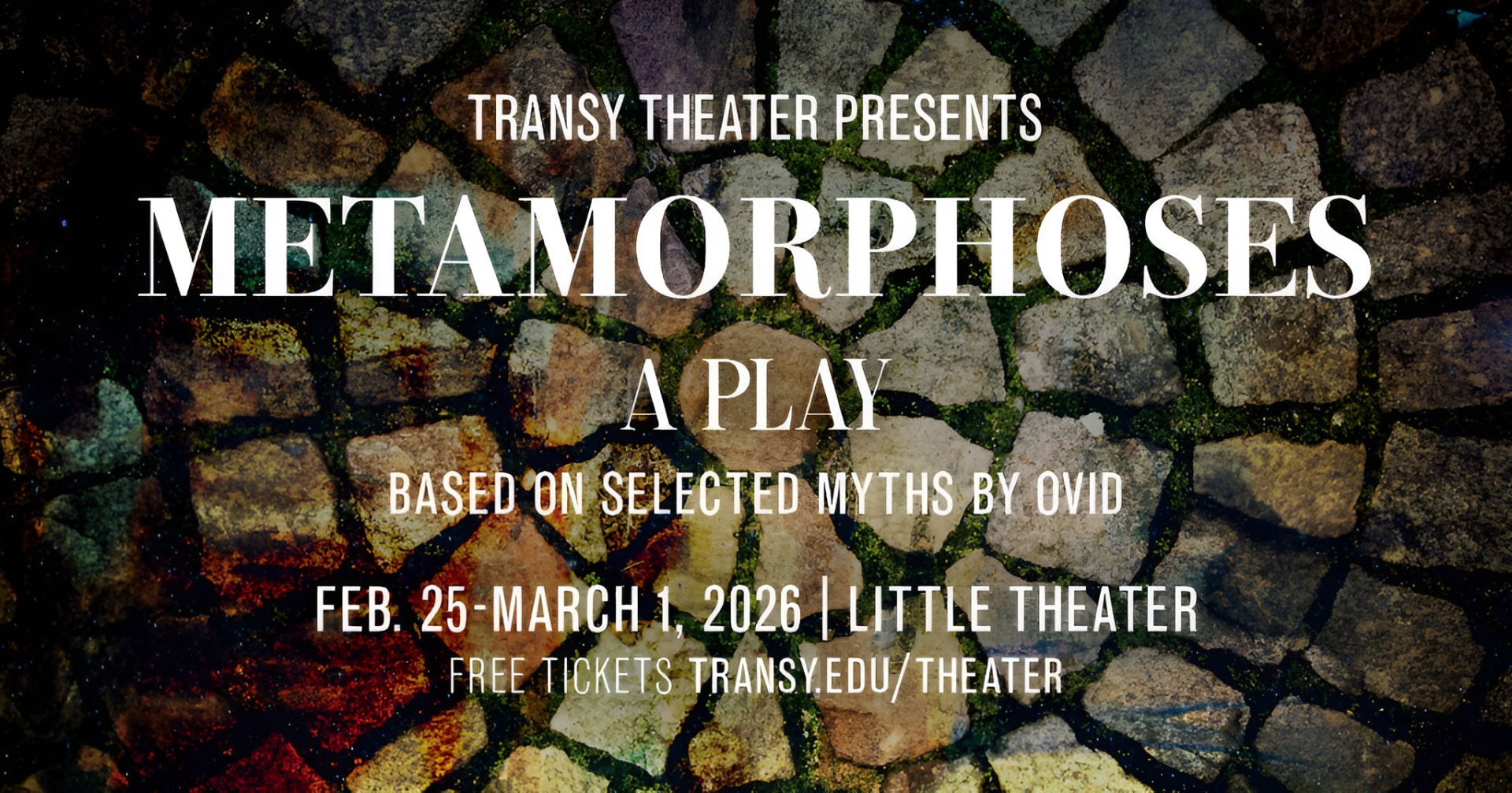
Performances run Wednesday, Feb. 25, through Sunday, March 1. Shows are at 7:30 p.m. Wednesday through Saturday and 2 p.m. Sunday. Admission is free. Tickets are available at transy.edu/theater.
Based on the epic poem by the Roman writer Ovid, “Metamorphoses” transforms ancient myths into a theatrical experience that feels immediate and contemporary. First developed by Chicago’s Lookingglass Theatre Company, the play went on to Broadway in 2002, where it earned three Tony Award nominations, including Best Play. Zimmerman won the Tony Award for Best Direction of a Play.
Time magazine called it the “theater event of the year.”
The play has become known for its striking stage imagery, particularly its use of water as both setting and symbol. In many productions, a large pool anchors the stage and serves as everything from river to sea to underworld. The water reflects the play’s central theme of transformation, as characters shift forms, identities and destinies.
At Transylvania, Tosha Fowler, the Lucille C. Little Endowed Chair in Theater and director of Transylvania’s theater program, is reimagining that iconic staging.
For Fowler, staging “Metamorphoses” also meant reimagining one of its most iconic elements. She remembers seeing the 10-year anniversary remount of Mary Zimmerman’s original production with its original cast — a legendary show in Chicago during her graduate training at The Theatre School at DePaul University.
“I was deeply moved by the stories,” Fowler said. “But as the performance went on, the centralized element of the pool became less and less interesting to me.”
When she revisited the script years later, that same staging choice gave her pause.
“The pool is such an integral part of Zimmerman’s adaptation that for a long time, I wrote the script off as something that just wasn’t interesting to me to direct,” she said. “But the ancient stories kept calling to me.”
Last year, she picked the script up again — and this time, it landed differently.
“I read it and wept,” Fowler said. “I knew the timing was right. I knew the student body was right for these stories.”
What followed was nearly a year of collaboration with student designers and the production team to reconceptualize the visual world of the play — shifting from a literal pool to a sacred worship space. The result is a production built piece by piece through shared imagination.
“We didn’t replicate what someone else envisioned,” Fowler said. “We dared to imagine a world by us, for us. This is something these students will look back on and know their time together was the instrumental building block of this particular production.”
Zimmerman’s adaptation blends heightened language with modern speech patterns, allowing stories thousands of years old to feel urgent and recognizable. Audiences encounter tales of love, grief, betrayal and redemption. The myths include stories such as Orpheus and Eurydice, King Midas and Phaeton, each exploring what happens when human desire collides with forces beyond control.
Though rooted in classical literature, “Metamorphoses” is known for its accessibility. The storytelling centers on emotional truth rather than academic interpretation. Viewers do not need prior knowledge of mythology to connect with the characters or themes.
Fowler saw the impact of “Metamorphoses” take shape in her classroom long before rehearsals began. In her first-year writing seminar this fall, students studied the play in depth and were challenged to wrestle with timely questions: Why do this show now? Who should it be for? And why?
“In their research and writing, they kept returning to the history of how ancient stories bring communities together — to learn, to laugh, to cry and to heal,” Fowler said. “In times that feel so divisive to them, that sense of togetherness is exactly why they chose to come to college and why they would choose to see ‘Metamorphoses.’”
For Fowler, the production ultimately comes down to what audiences carry with them when they leave the theater. “I hope they leave with the final two lines of the play in both their minds and their hearts,” she said. “Let me not outlive my own capacity to love. Let me die still loving, and so never die.”
Since its Broadway run, “Metamorphoses” has been staged by professional and university theaters across the country and is widely regarded as a modern American classic. Its ensemble structure challenges actors physically and emotionally, requiring fluid movement between roles, tones and theatrical styles.
This production also reflects the transformative power of a Transylvania education. Senior Sommer Abrahim arrived intending to pursue engineering and had never participated in theater, but after taking technical theater she discovered a passion that reshaped her path. She now serves as technical director for “Metamorphoses,” will graduate with a degree in theater design and technology, and recently completed an internship at The Porthouse Theatre in Ohio that has already led to job offers and graduate school interest. Taylor Dooley, a double major in political science and theater, is stage managing the production after overseeing every Transylvania show for the past two years while also working at a Lexington law firm, demonstrating how creative and analytical disciplines thrive together in a liberal arts environment. Samantha Farr, a double major in psychology and theater performance, has starred in numerous campus productions and is now interviewing for graduate programs in therapy, blending artistic training with a calling to serve others. Together, their journeys mirror the theme of transformation at the heart of “Metamorphoses” and show how Transylvania encourages students to explore widely and discover new directions.
For Transylvania students, the production represents both a creative challenge and an opportunity to bring ambitious visual storytelling to campus.
“Metamorphoses” runs Feb. 25 through March 1, in the Little Theater at Transylvania University. Performances are at 7:30 p.m. Wednesday through Saturday and 2 p.m. Sunday. Tickets are free and can be reserved at transy.edu/theater.
For those looking for things to do in Lexington in late February, this production offers a rare chance to see a Tony Award-recognized play reimagined by Transy Theater in an intimate campus setting.