Transylvania University anthropology professor Hande Ozkan has built a dynamic scholarly career bridging history and the perspectives of science and technology.
Ozkan was transitioning from history to anthropology near the end of her doctoral studies at Boğaziçi University in her native Turkey, a move that took her to the University of Washington and eventually Yale, where she earned her Ph.D. This shift allowed her to blend historical methods with anthropological insights, focusing much of her work on Turkey’s forests as complex sites of human-environment interaction. Ozkan’s research combines rigorous archival analysis with immersive ethnographic fieldwork, revealing how natural landscapes shape — and are shaped by — culture and science.
Three publications highlight her scholarly path, marking distinct phases of her evolving interests.
Ozkan’s first works focused on the historical role of forestry in early 20th-century Turkey. Her article “Remembering Zingal: State, Citizens, and Forests in Turkey” was published in the prestigious International Journal of Middle East Studies. It examines the Zingal forestry enterprise as a window into environmental management and societal relations over time. Drawing on archival records and personal memories, she highlights the layered narratives surrounding this operation, spanning the 1920s and ’30s into the 21st century. Ozkan notes the significance of the piece appearing in a Middle East-focused journal, and that Turkey doesn’t neatly fit that category. “I have never considered Turkey as part of the Middle East,” she explained, a perspective she explores in her teaching.
This theme of complicating regional boundaries resonates in her courses, such as “Representing the Middle East,” where students read full-length books to explore representations of the region — and question what defines any area of the world. The class begins and ends with books on Turkey, emphasizing its ambiguous place in broader geographic and cultural discussions.
Her research then expanded into landscape representations. In a chapter for the anthology “A New Ecological Order: Development and the Transformation of Nature in Eastern Europe,” Ozkan explores how European and American travelers, alongside Ottoman and Turkish scientists and bureaucrats, depicted Ottoman and Asia Minor landscapes — particularly forests. With a strong historical focus, her chapter “Goats, Axes, and Uncertain Narratives: Representations of Nature and People in Asia Minor” addresses Orientalist portrayals by both outsiders and local intellectuals, emphasizing the nuanced, non-monolithic nature of these depictions.
Ozkan seeks “loopholes” in dominant discourses like Orientalism and nationalism, arguing that colonial or nationalist narratives are never fully homogeneous. She sees this as crucial for challenging rigid views. “I’m very critical of definitions,” she said, noting how concepts can oversimplify complex realities. By uncovering competing narratives in archival records, her work aims to “unwrite or unlearn some of the taken-for-granted things, and maybe rewrite some of our historical records.” These insights not only drive Ozkan’s research but also enrich her teaching, where she references her own publications across Middle Eastern and Eastern European contexts to illustrate the “heterogeneity of regions, or how, to a certain extent, they’re pointless and meaningless entities.”
This evolution led Ozkan deeper into science and technology studies (STS), an interdisciplinary framework that has gained prominence in anthropology and other fields over the last decade. STS bridges materialist and constructivist views (ideas like nature as socially built). “What is really nice and fascinating about science and technology studies is that, with their focus on materiality, they also have been able to incorporate constructivist perspectives,” she said. This approach allows her to attend to both physical realities and social constructions without getting caught in academic divides.
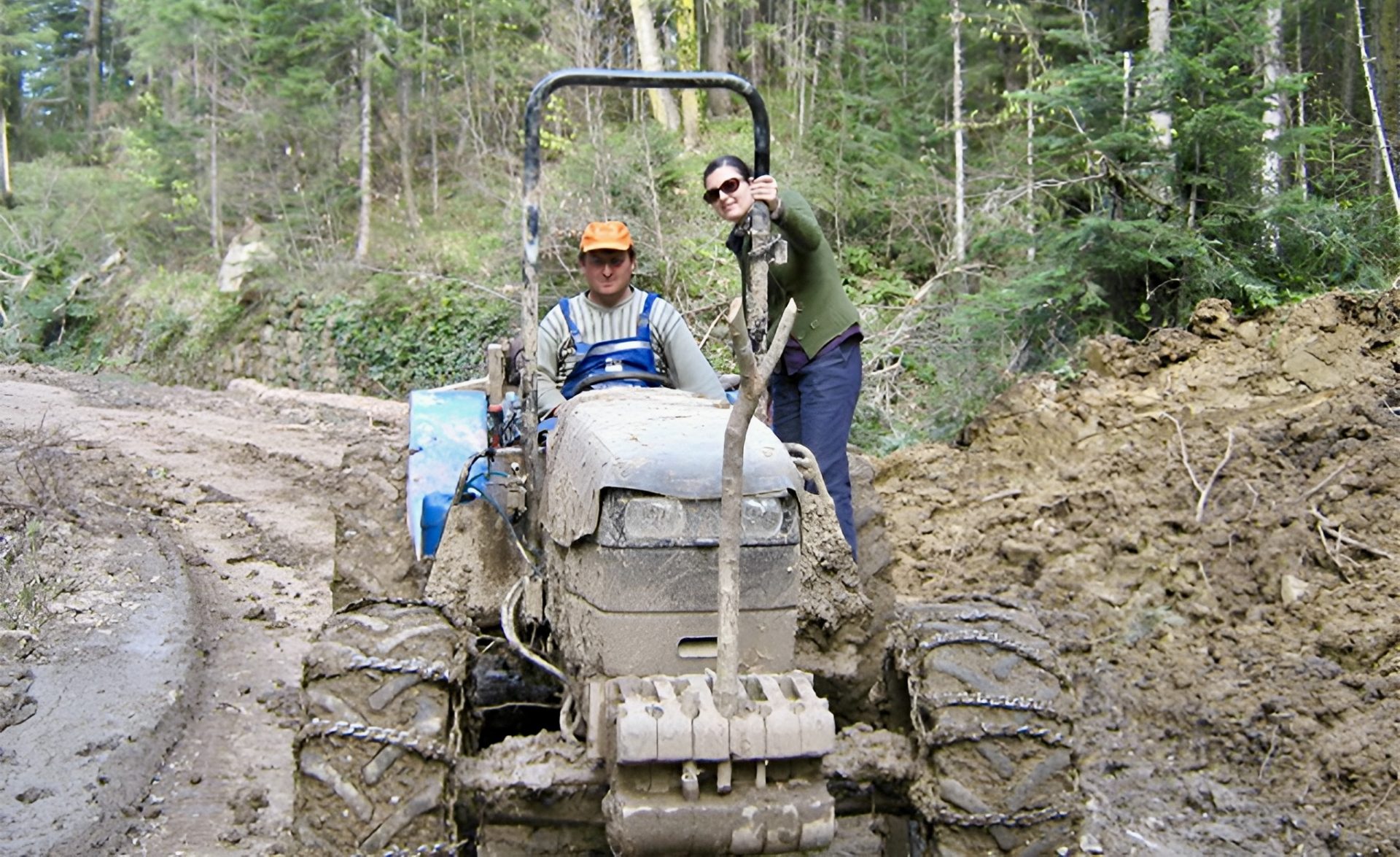
Ozkan’s chapter “The Liminal Forest: Mud, Science, and Nationalism in Turkey’s Forests” in the recently published book “Material Politics in Turkey,” applies an STS framework to forestry. Although she was familiar with STS from her anthropology theory class, writing the chapter encouraged her to revisit her archival and fieldwork materials through this lens — plus she’d always wanted to contribute to a volume solely focused on Turkey since joining Transylvania. In the piece, Ozkan argues that forests occupy a liminal space, neither fully land nor water. Mud, a constant in her fieldwork, embodies this: “I now see mud as the quintessential definition of the forest.” She recounts personal experiences like getting stuck in mud during fieldwork and spending two hours watching forest workers wash timber, highlighting how mud shapes labor, access and ecosystem views. “Mud is a crucial component of forests and forest labor,” she said, noting its role in complicating idealized notions of wooded landscapes. Liminality, a core anthropological concept from ritual studies, has become central to her work in questioning strict definitions.
Looking ahead, Ozkan is excited about new directions that continue her interdisciplinary thread. One project revives her interest in 20th-century British traveler Freya Stark, comparing her writings on different regions of the Middle East and Turkey to explore shifting cultural depictions over time.
Also intriguing is her emerging research on yogurt — a staple of Turkish cuisine whose cultural meanings have transformed dramatically. Originating in the region around Turkey, yogurt was once dismissed as “a poor peasant’s food” in the early 20th century. Today, amid interest in probiotics, it’s gained global prestige. (It wasn’t common in the U.S. until the late 1970s). Ozkan — who, in an ironic twist, admits, “I have not eaten yogurt since I was one year old” — plans archival and ethnographic work to trace these changes within an STS framework.
Through such research, along with publications and teaching, Ozkan consistently bridges disciplines, offering fresh insights into the environment, culture and knowledge production. Her ongoing work promises to enrich anthropological understanding at Transylvania and beyond.