Our students often come to college understanding the benefit of knowing another language. The main surprise is not about the usefulness of Spanish, French or Chinese, but about how easy it is at Transylvania to minor or even double major in one of these languages, since more than half of a student’s coursework toward the major and almost all of a student’s coursework toward the minor can fulfill General Curriculum requirements. In other words, students can major in biology, business or history and acquire a second major in a foreign language without having to overload or stay an extra semester. This allows them to graduate with a high level of fluency in a second language and a deep understanding of other cultures.
The study of a foreign language not only teaches students how to communicate in another language, but also teaches the history and culture of the countries that speak that language. Furthermore, it helps students understand the grammar of their own language and makes them better communicators in English, giving them a deeper understanding and control of, and a wider vocabulary in, their native tongue.
Students who major or minor in a foreign language do better on graduate school admission tests. Graduates who have high fluency in a foreign language also have better opportunities at companies with international offices. In fact, in 2023, Forbes found that bilingual job applicants had a 35% boost in both job prospects and salary. A foreign language also allows students the opportunity to do research abroad with greater ease and independence. This is true whether the research is in the humanities, social sciences or hard sciences. Foreign language graduates at Transylvania have often been able to take a gap year abroad between graduation and graduate school or employment.
Over the years, a favorite class of mine has been literary translation. Students learn about the craft and art of translation. They study the grammar and syntax of both English and Spanish and work on translating literature. It is not only fun to play with language in the way that we do — paying attention to imagery and music, to sense and sound, to form and function — but it is also rewarding to see how students come away with a deeper understanding of this uniquely human skill: the ability to create new worlds and share feelings through nothing more than words.
Once students reach a certain level of language competence, they read important literary works — poems, stories and novels — that deeply examine the human condition. They do this across a cultural divide. These stories, in turn, enlarge their imagination. They help shape students’ understanding of how the world works and how and where we fit into the larger world. Students also study the history and cultures of the countries that speak Spanish (or French or Chinese), which helps prepare them to be global citizens.
One common myth or misconception is that a foreign language, because it is not the language students grew up speaking or the lingua franca of their school, has little to no bearing on the rest of their studies. But the study of a foreign language has been shown to improve cognition, with positive effects on memory, attention and reasoning; to enlarge native-language vocabulary; to slow the aging of the brain; and to improve creativity.
Rather than speaking about a “liberal arts” approach to a discipline, I would speak about a liberal arts education. A liberal arts education asks students to study widely rather than narrowly. It holds that by having students take classes across the sciences, humanities, social sciences and arts, they will better understand the world and how to navigate it. This, in turn, frees them to make better decisions as they find their way through the world.
A student who is bilingual, who understands how statistics work, how macroeconomics and microeconomics function, and who understands that history is much more than the memorization of dates — but rather the story of how we got to where we are and an argument about meaning — is a student better prepared to be a citizen. The study of a foreign language is a little bit of many disciplines: linguistics, literature, history, anthropology and even politics. It is a perfect complement to a liberal arts education.
About the Author
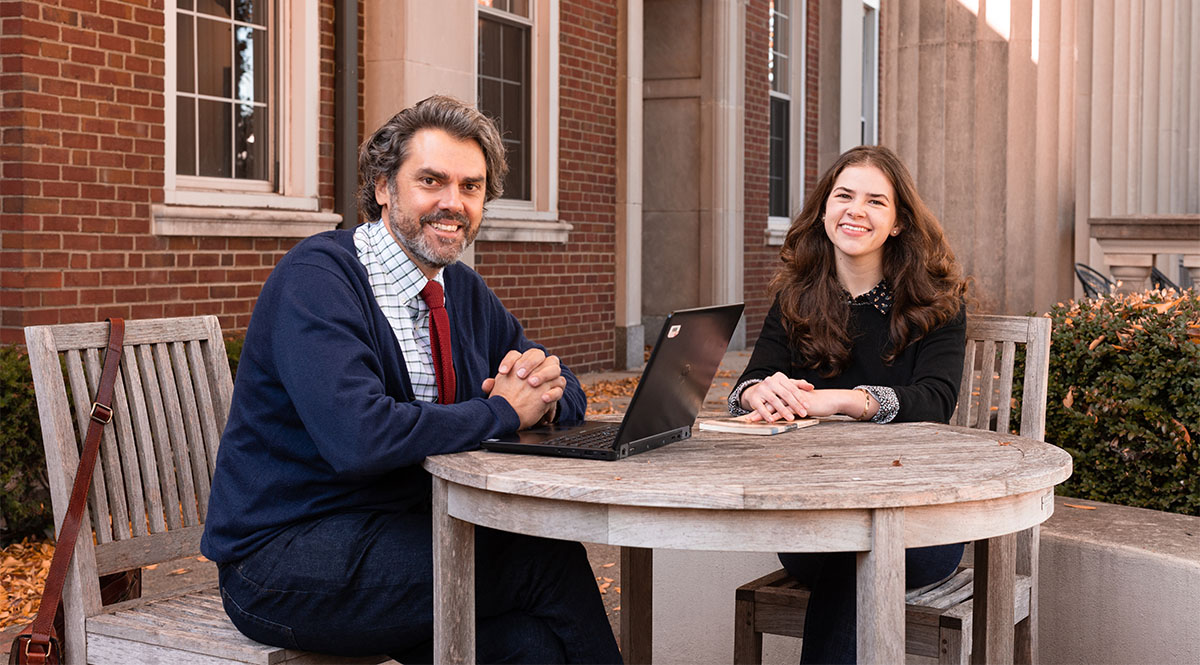
Jeremy Paden is a professor of Spanish and chair of the Division of Humanities at Transylvania University. He also teaches courses in Latin American and Caribbean studies and is passionate about language, culture and translation. Growing up in Italy, Latin America, the Caribbean and the United States, Paden brings a global perspective to his teaching and scholarship. He holds a Ph.D. in Spanish from Emory University and has written and translated poetry and literary works in both English and Spanish. His commitment to language and culture reflects his belief that there is no divide between language and the world it describes. (Photo: Professor Paden collaborated with Tatianna Verswyvel ’22 on translating poetry into Spanish.)